
Guest Post: The EU-China Deal on Hybrid Vehicles Safeguards: A Win-Win Outcome? For Whom?
This is a guest post by trade lawyer Victor Crochet and law professor Weihuan Zhou
Following months of escalating trade tensions, the EU and China reached an agreement on several points of contention during their second meeting on bilateral trade and investment on 8-9 October. One of the key issues at stake concerns imports from China of hybrid vehicles. China’s rise as a global leader in electric vehicle (EV) production and exportation has imposed unprecedented pressure on traditional auto powerhouses including the EU, provoking the adoption of temporary protective measures (e.g. tariffs) and longer-term industrial policy in the pursuit of a systemic overhaul and upgrade of local auto sectors (e.g. EU’s Industrial Action Plan for the European automotive sector). The EU’s countervailing duties, imposed on Chinese EVs in 2024, has led to a phenomenal growth of imports of hybrid vehicles from China while Chinese EV imports flattened. As European car makers announced job cuts in response, this has fueled fears of deindustrialization in the EU and brought up the issue to the top of the EU’s trade agenda since the beginning of this year.
As reported in specialized media, the two sides agreed to limit imports of hybrid vehicles from China into the EU at around 350,000 vehicles per year over the next four years. They indicated that this would be implemented, not through export restraints as initially suggested by the EU, but through safeguard measures. Given that voluntary export restraints are generally prohibited under Article 11 of the WTO Agreement on Safeguards, they claimed that such an approach would ensure WTO-consistency.
Safeguard measures are one of the WTO-permitted trade restrictive instruments for governments to shield domestic industries from import competition temporarily. They are meant to address situations where trade is fair but an increase in imports resulting from unforeseen developments causes or threatens to cause serious injury to a given domestic industry. Where these conditions are fulfilled, a WTO Member can impose a safeguard measure, by way of tariffs, quotas or other forms, to restrict imports irrespective of their sources (in other words, erga omnes). In contrast with anti-dumping and countervailing measures which have strict rules on how to design the measure and its level, safeguard measures can be applied to the extent necessary to prevent or remedy the injury concerned and to facilitate structural adjustment of injured industries, thereby leaving more discretion to the imposing WTO Member. The rules of the WTO Agreement on Safeguards are incorporated in the EU’s Basic Safeguard Regulation.
Since the bilateral meeting, the EU has publicized widely that it will launch a safeguard investigation on imports of hybrid vehicles to impose (provisional) safeguard measures by December this year. EU officials have advertised that the measures would take the form of a quota based on the level of imports into the EU in 2025 plus a mark up of a few percentage points to account for growth in demand. This quota will apply to imports from all countries but the largest exporters to the EU (China, Japan, UK, Korea, US and Türkiye) will get country-specific quotas. Other exporters will share a residual quota.
The EU’s safeguard measure, as proposed, raises several issues. From a legal point of view, it is difficult to see how a safeguard measure, pre-determined through an agreement between the EU and China, can be legal under the WTO Agreement on Safeguards and the EU Basic Safeguard Regulation. Such an ex ante agreement means that the perceived measure will be put in place regardless of whether the legal conditions are met. Given the pre-determined outcome, it is likely that the investigation will be performative only paying lip service to these requirements and the due process required for interested parties. From a diplomatic point of view, the EU’s trading partners, particularly traditional car exporters, were left out of the negotiations and will have little influence on the safeguard investigation. New developments from the investigation that benefit other trading partners may change the dynamics of the EU-China relations and necessitate an adjustment of the negotiated outcomes.
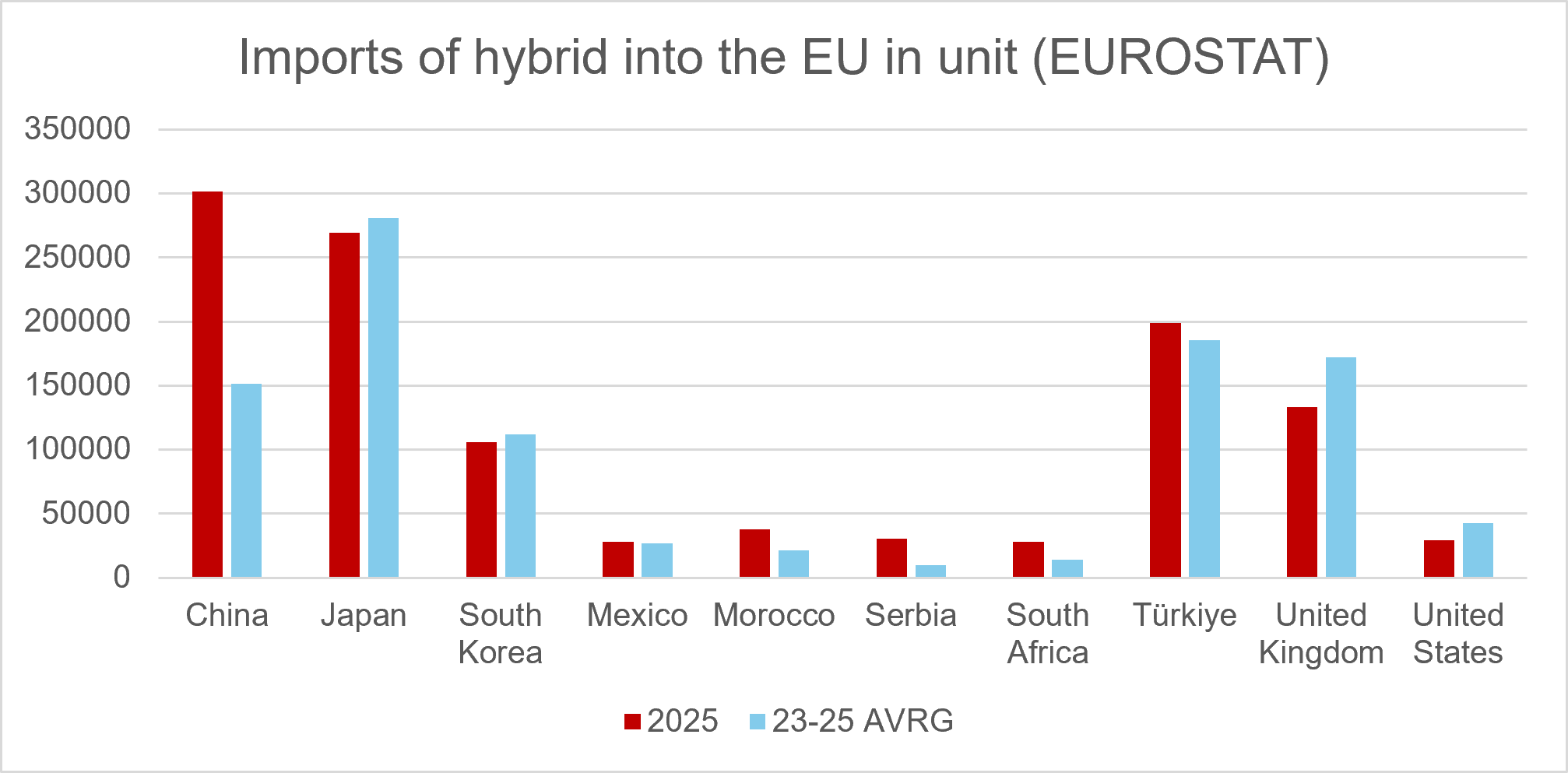
EU officials have claimed that this course of action will benefit trading partners by protecting their market share in the EU. However, since 2025, imports of hybrid vehicles from China have already soared. This is why China agreed to this deal to receive the highest quota and maintain a larger market share than its major competitors. The base rule in Article 5 of the WTO Agreement on Safeguards is that a safeguard measure taking the form of a quota should be established based on the average of imports in the last three years before the investigation. As there were little imports from China in 2023 and 2024 and more imports from other trading partners, this would have not suited China but could have been more agreeable to other car exporting countries (except Türkyie and not however that taking 2026 into account instead of 2023 in a three year average would have further benefitted China):
Furthermore, from a practical point of view, a quota on imports of hybrid vehicles is likely to limit imports at level below that of the quota. This is so because once the relevant quota is exhausted, no more imports can take place. Since the sea voyage can take months, there is no guarantee that sufficient quota quantity would still be available when the vessel arrives at the EU. Given the high cost of car-carrying vessel, car manufacturers will likely act on the side of caution and not start the journey if importation cannot be guaranteed.
Having avoided a full confrontation with China, the EU may nonetheless face one with its other trading partners by purporting to comply with WTO rules in form but not in substance and spirit. The EU already followed a similar path with regard to steel some months ago, leading to tensions. If such transactional methods become the EU’s standard playbook in response to intensified geoeconomic competition, it will set a bad template further undermining the already chaotic global trade order.
Yet, this does not have to be so. The EU could limit imports from China at 350,000 vehicles as agreed with China without affecting its other trading partners.
In the purported safeguard investigation, the EU Commission can apply the principle of parallelism embedded in Article 2.2 of the WTO Agreement on Safeguards (Appellate Body Report, US – Line Pipe, paras. 179-181). This principle provides that a WTO Member can exclude certain WTO Members from the scope of a safeguard measure as long as imports from such WTO Members are not taken into account when assessing whether the criteria to impose the measure are met. The EU has relied on this principle in the past, for example, to exclude the members of the European Economic Area as well as, temporarily, certain countries which had a free trade agreement with the EU mandating exclusion from its safeguard measures on steel in 2018. In the present case, the EU could similarly exclude its free trade agreement and customs union partners from the scope of the analysis and subsequently of the relevant measures. This would allow the EU to keep China in but exclude the UK, Japan, Korea and Türkiye.
One typical challenge here arises from the fact that Chinese car manufacturers have established production bases in third countries such as Türkiye, Morocco and Vietnam. Consequently, targeting solely China and excluding trading partners from the scope of a safeguard measure may render the measure less effective as Chinese car manufacturers can switch from exporting from China to exporting from a third country. Indeed, the EU has many free trade agreements including with the countries just mentioned. A parallel issue is European car makers themselves having delocalized production outside of the EU. Morocco and Serbia are prime examples of this where French and Italian car makers have invested. Excluding such countries with which the EU has trade agreements may thus simply incentivize European car makers to continue in that direction rather than maintaining production in the EU.
One way to address this issue would be for the EU to draw a line between trading partners which are excluded from the scope and others. This could be done based on the type of trade agreements the EU has with third countries (free trade agreement, association agreement, economic partnership agreement, etc.) or other objective criteria, although this may lead to claims of discrimination.
In any event, the solution proposed above would limit the fall out with trading partners which are not the cause of the issue and were not invited to the negotiating table. It would raise the same issue in terms of paper compliance with the WTO Agreement on Safeguards but would at least limit the number of partners affected.
Another option could be for the EU to adopt a specific regulation to do so through the ordinary legislative procedure (involving the Parliament and the Council) on the basis of the EU’s competence in trade (Article 207 of the Treaty on the Functioning of the European Union) as it did when it raised duties on certain products from Russia and Belarus in the midst of the war against Ukraine. This approach would likely be WTO-inconsistent except if an exception is available, but perhaps now is the time to drop the façade of WTO compliance when such compliance is not achievable in order to maintain the integrity of the system where it can still be preserved.