
Decision-Making in the Absence of Perfectly Spherical Cows
Last week, I had the distinct honour of participating in the plenary session that launched the WTO World Trade Report for 2026. You can check out the recording.
In the week prior, WTO Chief Economist Bob Staiger asked all of us speaking to prepare a quick answer in the final minutes of the session: if we had the keys to the house, what is one procedural and one substantive change we would make? I will save the substantive for another day and focus on my answer for procedure: I propose that a “blocking minority” be required, rather than the current approach, which allows individual Members to prevent a majority from moving forward.
Article X:9 of the WTO Agreement requires consensus of the Ministerial Conference to add a plurilateral agreement to Annex 4. Rather than rehashing the debate about the function and relevance of consensus, Members should consider how to better manage situations of non-consensus and the risk of a single point of failure or a monopoly on opposition.
The WTO rules do, as I explain below, allow for voting, as does the Vienna Convention on the Law of Treaties, for adopting text and amendments (see articles 9(2) or 40). Yet the WTO has become locked into a position in which Members cannot even contemplate voting. Though 131 Members may support the investment facilitation agreement, India maintains a very strong opposition. Expert scrutiny continues to debate whether there has been a recent softening of that position. Regardless, recent events expose a problem in multilateral governance, as Members appear to be in an infinite loop without an exit condition.
From a historical perspective, the ITO/GATT anticipated decision-making would require voting. The initial plan for an International Trade Organisation (ITO) would have included a co-legislator of sorts, with an executive board comprised of the larger economies. Article 75 of the Havana Conference draft ITO Charter empowered Members to vote and provided an opportunity to take a second vote in the event the first vote was less than half the membership, which would become ‘final whether or not the total of the vote cast comprises more than half the number of the Members.’ For amendments that did not alter Member obligations, the Conference would just vote, requiring a two-thirds majority (see article 100).
That said, the commitment to one-country, one-vote presumed ‘common consent,’ though not in all circumstances. As Clair Wilcox, head of the U.S. delegation negotiating the ITO Charter, would later explain, ‘There is no single sharp division of interest that will appear in every case. The line-up of votes will be constantly shifting, from issue to issue and from time to time.’ An ITO Member would make decisions based on its priorities and lobby partners to succeed in a vote. To paraphrase Wilcox, every country would win some and lose some. The United States had significant power in this story and, of course, had a kill-switch — withdrawal from ITO membership was the ultimate decision when any Member lost faith in the decision-making process.
Without the ITO, the GATT lacked extensive decision-making institutions. However, Mary Footer observed that the commitment to joint action in GATT Article XXV supported an approach that prioritised collective decisions and created an exception for voting. Understood together, voting could help build toward consensus, in the same way an interim agreement could lead to a comprehensive trade agreement.
Although the practice evolved to consensus-based decision-making, the GATT rules concerning voting were retained within the WTO framework. Currently, Article IX:1 confirms that the WTO “shall continue the practice of decision-making by consensus followed under GATT 1947.” Article IX further explains that, absent other guidance, the failure to reach consensus creates the opportunity for voting on a one-country, one-vote basis. Article IX:2 states that the Ministerial Conference may adopt interpretations by a three-fourths majority vote. Likewise, in “exceptional circumstances,” the Ministerial Conference may waive obligations if approved by three-fourths of the Members. By this account, a three-fourths majority can change the multilateral trading system. Yet, as many academics have studied and opined, Members have been unwilling to crack that egg, knowing that it would be impossible to put consensus back together again.
Without seeking to rehash the extensive literature on consensus and voting in the WTO, what I propose is that Members consider a qualified minority rule. In addition to requiring a qualified majority to move forward, with three-fourths of the Members making a decision, a qualified minority demands that a Member wishing to veto form a minority consensus to block a decision.
The decision-making rule would mean a requirement that three-fourths must be for YES and also that NO must be X amount (could be less than one quarter). A blocking minority places more accountability on the vetoing Members to convince a sufficient number of partners to join their opposition. It reflects the fact that the procedure must respect both poles of decision-making, those in agreement and those opposed. Incorporating this blocking minority accountability could facilitate more consensus-building, although only time would prove that hypothesis.
Old: Consensus and, failing that, 75% YES and silence on NO means the item can move forward.
New: Consensus and, failing that, 75% YES and [less than X percentage] NO means the item can move forward.
Within the European Council rules, a blocking minority is a close analogue. Article 16(4) of the TEU confirms qualified majority voting, of at least 55% of the Council members, comprising at least fifteen Member States or 65% of the Union population and a ‘blocking minority must include at least four Council members, failing which the qualified majority shall be deemed attained.’ Further research could explore the rationale and design for the Union to understand why this system introduced the counterbalance of the minority blocking, and how a similar process could benefit the WTO.
The minority block cannot be too small a number, as it would be too easy to game. One quarter of the membership would be about 40 Members. Even one-eighth of Members opposed may be sufficient to form a blocking minority. But somewhere between 20 and 40 Members could enable both the majority and minority to wrangle votes from allied partners, though there would be hope for more give and take and for blocks to form around issues. Members may acknowledge that the decisions taken need not guarantee their positions in bilateral or regional forums, but could reflect their position, though still subject to change, in the multilateral framework.
A blocking minority resolves the single point of failure but does not address other challenges with majority voting. As Ehlermann and Ehring point out, consensus decision-making may be ‘the least bad’ option compared with majority voting, as Members can passively abstain without formally objecting. Yet the value of consensus decision-making as a process may lose its salience if the trade-offs normally expected from finding a compromise solution among peers do not occur, especially when the matter at issue does not require Members to relinquish rights or to diminish their obligations.
Of course, implementing this new procedure would require Members’ consensus. Otherwise, Members are again looking at plurilateral options. In the plenary discussion, I spoke about plurilateralism and urged governments to recognise how the multilateral trading system respects the plurality of its membership, accommodating their varied approaches, while also committing to justified, transparent approaches and due regard when regulating trade. A veneer of legal universalism fails to show the dynamic, flexible system underpinned by diplomacy and context. Modernisation is not a single recipe, right?
More than ever, in the height of geopolitical rivalry and technology-driven growth, governments must find points of compromise and cooperation. Disagreements should rest on context, objectivity, and as much data as possible, rather than on preconceived positions. Members could use a blocking minority procedure as part of the guardrails for a future world of federated decisions, in which coalitions are formed, and cooperation and standards may develop in more varied contexts. A successful blocking minority could become the foundation for a minority plurilateral agreement, with a process for transition between the two put in place (or not, depending on the topic). Further, any agreement on this new decision-making process could (for now) focus on qualifying rights without diminishing existing WTO obligations. In other words, Members may agree that open plurilaterals benefit from this process, while reserving consensus for closed plurilaterals.
This brings me back to another point I made in the plenary. Any claims concerning the outdatedness of the multilateral trading system must be reconciled with a messy, complex history. Contrary to more conventional narratives, the system does not emerge from a context of post-war peace, any more than the ITO/GATT attempted to anchor that peace with rules committing all members to surrender discriminatory trade practices. The origin story begins in wartime, with the United States taking a formal lead during World War II. Better appreciation of that context illuminates the emphasis on experimentation and transition between wartime and peacetime economics. The ITO/GATT project was part utopian and part pragmatic. I have never come across a demand that it be a strict code of conduct. If anything, the system often felt the opposite: uniquely pliable as governments recognised extraordinary challenges with building a globalised economy in the wake of shifting rivalries and economic reconstruction. It helps explain why historians from Irwin to Zeiler to Heilleiner have remarked on the self-restraint of the United States, and as I have tried to show in my own work, how alliance-building factored significantly in the final network of rules and exceptions.
Finally, in the plenary, I made a physics joke about perfectly spherical cows – to make the point that Members do not benefit from solutions based on unrealistic assumptions. The world must find a solution for real life, where cows are not perfectly spherical. There will never be a perfect time to reform the system.
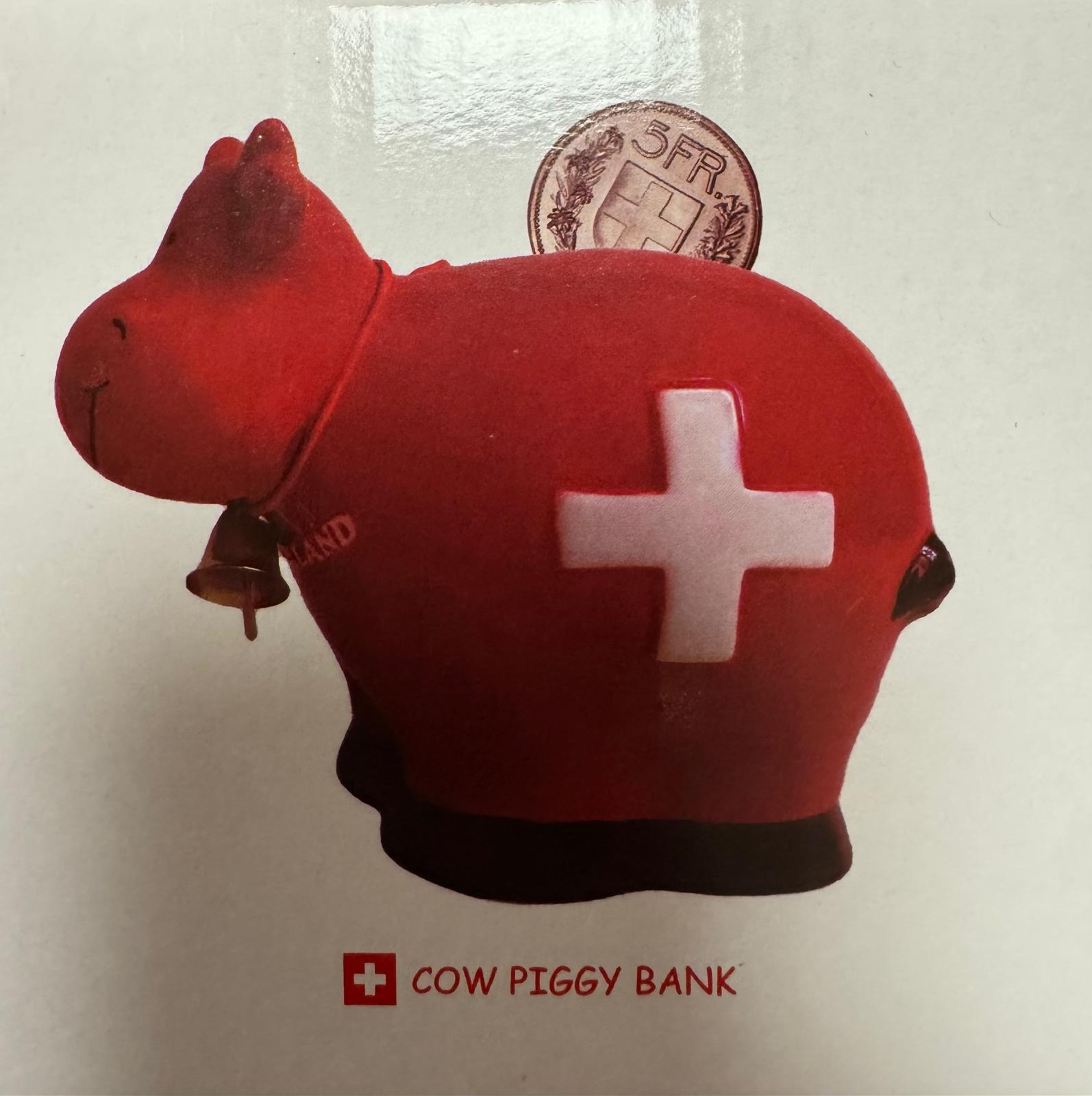
Though I did find a (nearly) perfectly spherical cow in the Geneva airport on my travels home.