
The Trump Administration Is Going After German Pharmaceutical Pricing. Will France Be Next?
Kiyan Slove-Rezvani is an IELP blog intern
Americans pay far more for brand-name drugs than Europeans do. For years that was treated as a domestic health problem. The Trump administration has started treating it as a trade problem, and in June 2026 it opened a Section 301 investigation into Germany's drug pricing.
This post asks whether a German-style 301 investigation would work against France (another European country often cited as a problem by U.S. government officials and pharmaceutical companies). It proceeds in three parts. First, it explains the Section 301 investigation against Germany, specifically, what USTR is alleging and why. Second, it explains how France sets drug prices, since similar action against France would have to address the system in place there. Third, it looks at the debate inside France over how to respond to American pressure, which turns out to be less united than it first appears.
The German Section 301 case gets things rolling
Section 301 of the Trade Act of 1974 provides a set of procedures under which USTR can investigate a foreign country's trade practices. Among other things, actionable conduct under Section 301 includes acts, policies, and practices of a foreign country that are “unreasonable or discriminatory” and “burden or restrict U.S. commerce.” If USTR finds that such conduct exists, the U.S. government can take action, usually with tariffs.
The key evidence behind USTR’s investigation in the German pharmaceutical case is that U.S. consumers pay roughly 3.9 times what German consumers pay for brand-name drugs. USTR traces that gap to two specific German practices. The first is a rule that ties price confidentiality to a discount, meaning a manufacturer can keep its negotiated price secret only by accepting a discount. The second is a draft law that would add a mandatory rebate on patented medicines, which the industry expects to grow over time. USTR’s initiation notice suggests that these practices – one in effect now, and the other possibly coming into force soon – together push German prices below fair market value and leave Americans to fund the difference (through higher prices in America).
The investigation against Germany grew out of the May 2025 “Most-Favored-Nation” executive order, which set out to ensure that U.S. consumers should pay no more for a drug than the lowest price paid by any comparable developed country. The Trump administration is trying to achieve this goal by raising foreign prices through trade pressure (there have also been moves by the administration to lower U.S. prices, although it remains to be seen how successful they will be). The United Kingdom already agreed to pay more for new U.S. medicines in exchange for tariff relief. USTR urged Germany to follow suit, but after months of talks, Germany instead advanced legislation to further cut spending on innovative drugs, and the investigation followed.
Will France be next?
Beyond Germany, France is another EU nation that has often been cited as a particular problem in relation to its drug pricing. In France, a single national insurer, the Sécurité sociale, covers nearly everyone. Because one buyer pays for almost every prescription (an arrangement that is used in many countries around the world), that buyer negotiates prices that apply to every purchase, and there is no free market price for prescription drugs.
Every individual drug proceeds through four steps before it has a price and enters the market:
- Authorization (AMM): The drug is approved for safety and effectiveness, usually through the European Medicines Agency. Price is not discussed at this stage.
- Grading (HAS): A public agency, the Haute Autorité de Santé, evaluates the drug through its Commission de la Transparence. It issues two ratings. The SMR decides whether the drug is useful enough to be reimbursed and sets the reimbursement rate; and the ASMR measures how much better the drug is than existing treatments, on a scale from I (major advance) to V (no improvement), and is the main driver of price.
- Price (CEPS): A government committee, the Comité économique des produits de santé, negotiates the actual price with the company. This is the step that matters most for what’s at issue with the current U.S. 301 investigation, for three reasons given below.
- Reimbursement rate (UNCAM): A separate body sets what percentage of the price the state pays back, and the health minister formally lists the drug.
The CEPS stage is worth focusing on, because it is where the price is negotiated between the state and the manufacturer, which is the same kind of government price-setting that the investigation against Germany targets. Three features of CEPS matter here:
- It is not independent. CEPS sits under the authority of the health, social security, and economy ministries. The state appoints its president and holds the majority of its seats.
- The company cannot simply walk away. If no agreement is reached, CEPS sets the price by its own decision. The relevant ministers can override that decision, jointly setting the price themselves within fifteen days, but the initial decision by CEPS does not require approval.
- The published price is not the real price. On top of the official price, the manufacturer pays confidential rebates (remises) back to the state, negotiated drug by drug. So the list price overstates what France actually pays.
The CEPS stage is likely to be the focus of a Section 301 investigation. The first two are clinical judgments, while the third is a budget decision. And the confidential rebates in step three are the same hidden discount USTR is attacking in Germany. This raises the question: does France show the same price gap that started the German case?
To check, we can turn to RAND Corporation's 2022 price comparison, which looks at U.S. prices compared to 33 OECD countries. Its figure for Germany, 3.87 times, lines up almost exactly with USTR's 3.9× claim, which makes it a reliable benchmark for measuring France in the same way. The RAND Corporation finds that U.S. prices for brand-name drugs are 445% of French prices and 387% of German prices. In other words, the U.S. pays about 4.45 times French prices versus 3.87 times German prices. RAND states plainly that France and Japan generally have the lowest prices for brand-name drugs among the 33 OECD countries in the analysis.
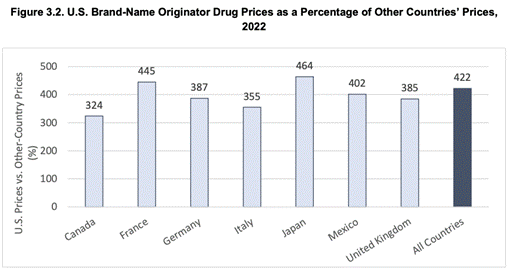
Source: RAND Corporation, International Prescription Drug Price Comparisons: Estimates Using 2022 Data (RRA788-3), Figure 3.2, p. 17.
The same pattern appears in the HHS/ASPE analysis of the same data: U.S. brand-name prices were 422% of the average across 33 OECD countries, whereas U.S. generic prices were actually lower, about 67% of other countries' prices. The price gap is therefore a brand-name phenomenon. On generics, which make up 90% of U.S. prescription volume, the U.S. pays less than its peers.
There are two caveats to keep in mind. All of these figures are gross, list-based prices. RAND could adjust the U.S. side down for rebates (bringing the brand-name figure from 422% to 308%), but it could not do this adjustment for countries where there are confidential rebates. RAND notes specifically that “German sickness funds receive statutory rebates not reflected in manufacturer sales.” France's remises work the same way. So the true gap that France has is actually smaller than 4.45 times by an unknown amount. However, the main claim holds: on brand-name drugs, the category USTR is targeting, France is a bigger outlier than Germany.
The French response
France is not united on the issue, with a strong internal divide emerging. In 2026, a rare coalition formed on a proposal to make the real, net prices of drugs public, instead of keeping the rebates secret. The left (La France insoumise, the Socialists, the Communists) and the National Rally, parties that agree on almost nothing, all supported it. In parliament, opposition came from the presidential majority, which voted against. The executive and the relevant ministries also warned that transparency would strip France of its main bargaining tool, prompting some criticism, such as from Médecins du Monde.
Other groups have entered the debate too:
- Industry (LEEM): The drugmakers' association, LEEM, wants the government to freeze price cuts and abolish the safeguard clause (a yearly cap on total drug spending: if national drug sales exceed the limit, manufacturers collectively pay back the overage). It warns that new tariffs on medicines would threaten patient access and drug supply. LEEM was also questioned directly by the Assemblée nationale on pricing mechanisms in March 2025.
- Critical press (Veltis/Le Figaro): The argument here is that if the U.S. forces lower prices at home, companies will raise prices in Europe to compensate, and France, with some of the lowest prices in Europe, is the most exposed. Veltis, a consultancy quoted by Le Figaro, put it bluntly: to protect their main market, companies “will have to raise the prices negotiated in Europe… or give up selling their new drugs there.”
- Reformist (Bizard): The economist Frédéric Bizard argues that France should treat the American pressure as a chance to rebuild a pricing model he considers broken, rather than a threat simply to resist. He also confirms the mechanism that connects the American policy to France directly: because the U.S. now targets the lowest price in Europe, and that price is often France's, companies such as Pfizer threaten not to launch new drugs in France at all.
Some tentative predictions
So, would a Section 301 investigation along the lines of the one underway against Germany work against France? Just looking at the numbers, if you apply USTR's analysis of the German policies to the French situation, the case is there. The price gap that justified the German investigation is not only present for France, it is larger. And the French system concentrates price-setting in a state committee, which provides evidence of a government practice of the type Section 301 is designed to address. At the same time, whether any such practices – in Germany, France, or elsewhere – are “unreasonable or discriminatory” and “burden or restrict U.S. commerce” is a question still open for debate (although the Trump administration's views on this are probably not in doubt at this point).
A complicating factor here is the same one running through the whole story: France's low prices come partly through confidential rebates, the same secrecy USTR is attacking in Germany. That makes the gap real but hard to measure exactly. Whether the administration turns to France next may come down not to the strength of the case, but to the particular priorities of the Trump administration, along with various non-trade aspects of the U.S.-French relationship.