
Guest Post: Takeaways from Recent U.S.-China Trade Deals
This is a guest post by Bryan Riley, Director of the National Taxpayers Union’s Free Trade Initiative
Details of the Trump Administration’s recent deals with China have yet to be released, but a few key goals have been announced by the White House.
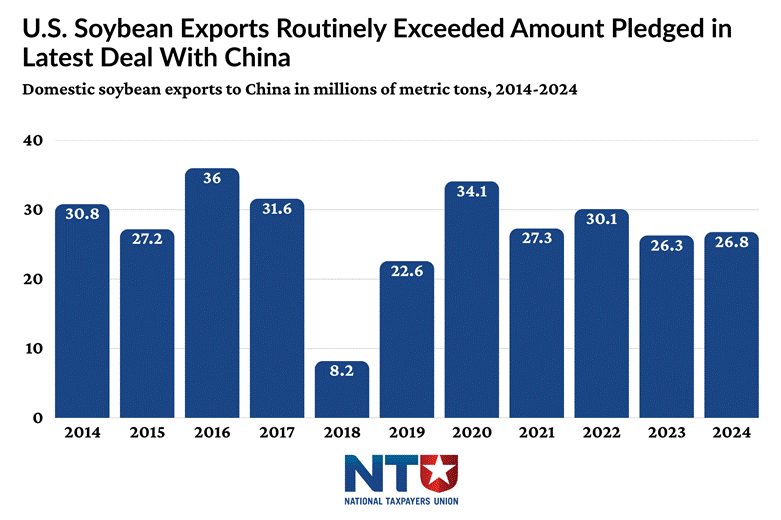
✔ China will meet its 2025 pledge to buy 25 million metric tons of U.S. soybeans in 2026, 2027, and 2028. This should be an easy goal to reach. With the exception of the trade war years of 2018–2019 and 2025, soybean exports to China topped that amount for every year since 2014.
✔ China will buy at least $17 billion per year of U.S. agricultural products in 2026 (prorated), 2027, and 2028, over and above its soybean purchases. If met, this will be a significant export increase above the 2022 peak of $14 billion for agriculture, fishing, hunting, and forestry exports to China other than soybeans. It would be an even bigger increase from last year’s non-soybean agricultural exports to China of just $2.5 billion.
✔ China will purchase 200 U.S.-made Boeing aircraft. It is not yet clear which models China will purchase or when the delivery dates will be. The previous high for deliveries was 202 aircraft in 2017. At the time, Boeing announced an agreement to sell 300 aircraft during a trade mission to China. Most of those sales never materialized. Hopefully this deal will be more durable.
✔ China will address U.S. concerns regarding critical minerals. Regardless of what actions China may undertake, the United States can take several steps to improve our position. These include adopting domestic permitting reforms to facilitate domestic production and ending tariffs on imports of aluminum, copper, tin, and other critical minerals supplied by trading partners that are not U.S. adversaries.
✔ The United States and China will create a Board of Trade to manage trade in non-sensitive goods and a Board of Investment to discuss investment-related issues. Establishing forums to head off potential conflicts may be helpful, but creating a new U.S.-China agency to “manage” trade in goods like toys and clothing is unnecessary. Managed trade tends to create new bureaucracies and increase barriers. Mutually beneficial trade in non-sensitive products should be freed, not managed.
What to look for next:
Related issues to watch include the proposed renewal of Section 301 tariffs on China that were imposed during his first term. The Biden Administration determined that China’s policies failed to improve in response to Section 301 tariffs, and then took the unprecedented action of extending them for an additional four years.
The Office of the United States Trade Representative (USTR) has initiated a second review of existing Section 301 tariffs and launched investigations into “excess capacity” and forced labor. However, USTR has yet to dispute a single Chinese action at the World Trade Organization (WTO). This is a missed opportunity, given the poor track record of unilateral Section 301 actions compared to WTO disputes initiated by the United States.
The Trump Administration should take this opportunity to build on recent successful policies such as its waiver of the Jones Act to facilitate transportation of oil, natural gas, and other resources that Americans rely on, and its decision to exempt many goods from its 10% Section 122 tariffs, including certain critical minerals and fertilizers, tomatoes, pharmaceuticals, and cars and trucks. Additional steps to increase the flow of goods would demonstrate a commitment to affordability and would provide an economic boost to mitigate costs related to conflict in the Middle East