
The Section 301 Excess Capacity Investigation Needs Less Madness, More Method
Shortly after the Supreme Court ruled President Trump’s emergency tariffs under IEEPA unconstitutional, the administration scrambled to rebuild its tariff wall. While the announcement of Section 122 tariffs immediately following the ruling will provide a temporary patch, the U.S. Trade Representative’s office quickly began to utilize another tool that could provide a more durable solution.
In early March 2026, USTR initiated a new wave of Section 301 investigations, one of which focuses on the “acts, policies and practices” of sixteen economies that USTR alleges “appear to exhibit structural excess capacity and production in various manufacturing sectors.” However, exactly how “structural excess capacity” is to be diagnosed in a given country is unclear.
In setting out the scope of its investigation, USTR applies multiple definitions of excess capacity across each of the economies in question. The presence of “excess capacity” in an economy is primarily based on whether it shows any of three signs: low manufacturing capacity utilization, a bilateral or global trade surplus, or a range of policy interventions that may lead to excess capacity. We briefly explain each of these definitions and why USTR’s obfuscation of the specific “act, policy, or practice” at issue undermines the administration’s ability to actually tackle the stated problem.
The Endogeneity Problem
One definition USTR offers for excess capacity is “under-utilized industrial production capacity that is sustained through governmental interventions or policies incentivizing companies to maintain or grow their unused capacity inefficiently.” To this end, USTR cites the investigated economies’ manufacturing capacity utilization rates. USTR suggests that their “low” capacity utilization rates may provide evidence of anticompetitive policy interventions that inflate production capacity. However, several factors confound USTR’s understanding of capacity under-utilization.
First, there is no clear benchmark for under-utilization across sectors. USTR warns of economies “below healthy utilization rates for many sectors of approximately 80 percent,” citing a policy target rate defined separately by the Trump administration for the steel sector, despite different industries persistently having different utilization rates. In addition, there is considerable variation across other factors that shape production outcomes, such as demand volatility and capital intensity.
Second, USTR notes that U.S. manufacturing capacity has been under-utilized for years, yet continues to cite the investigated economies’ “low” capacity utilization rates as evidence of their structural excess capacity. As the figure below shows, American manufacturing capacity utilization has recently hovered around 75 percent, which is lower than most of the economies under investigation, as detailed in the table that follows.
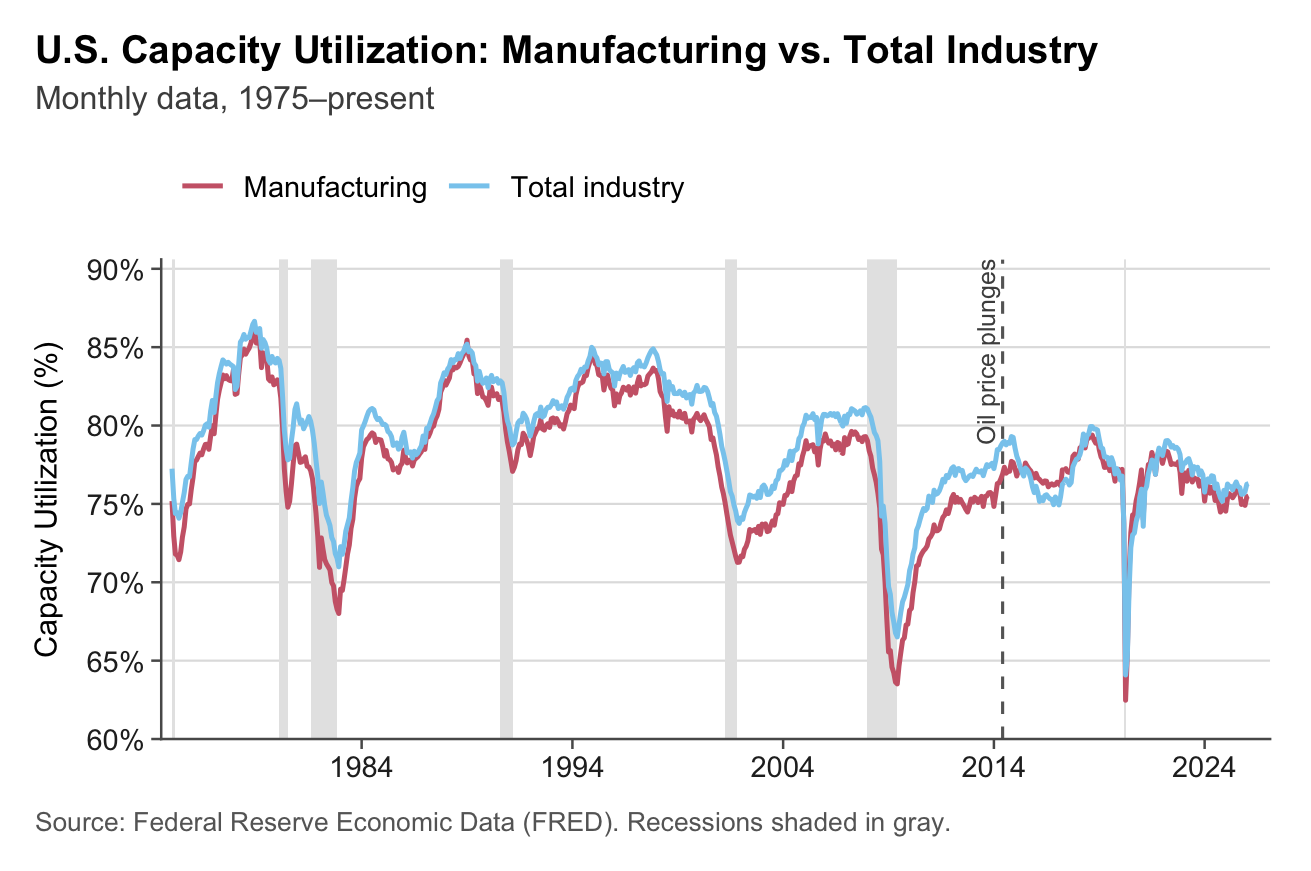
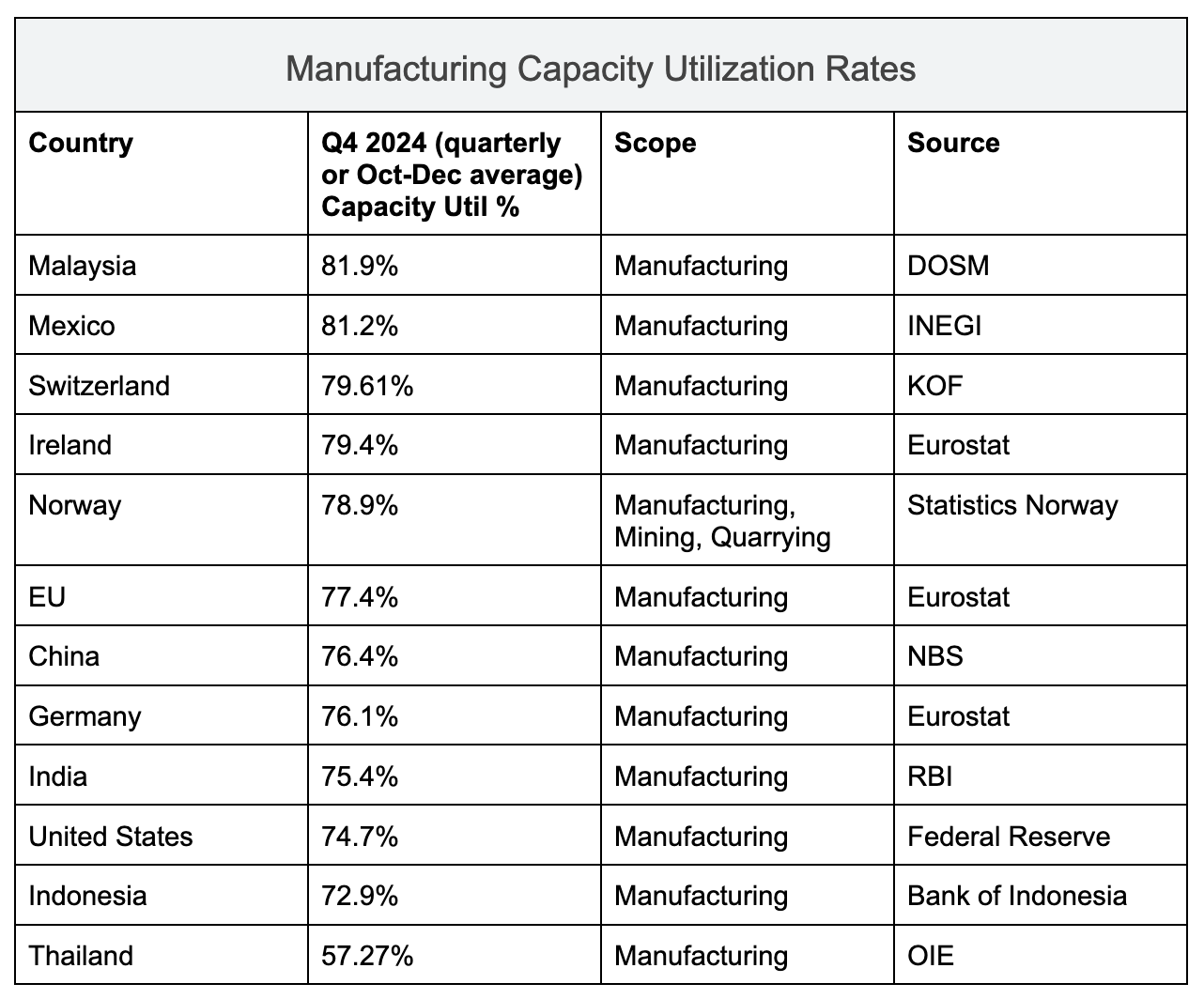
USTR attempts to explain this apparent double standard in interpreting capacity utilization rates by portraying American under-utilization as a consequence of other nations’ overcapacity displacing U.S. domestic production, but in its initiation notice does not provide evidence demonstrating the one-sidedness of this channel.
Furthermore, in the initiation notice, USTR neglects to cite specific examples of the “policies incentivizing companies to… grow their unused capacity inefficiently” in a majority of the economies under investigation, making it especially difficult to assess their claim that foreign and American capacity under-utilization is only a consequence of foreign government interference in the market.
Incomplete capacity utilization may arise naturally in equilibrium. Firms’ relative capacity to one another helps to attract demand; firms are therefore unlikely to cut nominally-inefficient capacity to avoid losing their gains from relative capacity. Automation and technology, changes in industry composition, firm-level decisions to offshore production, as well as skills mismatches and labor shortages also impact capacity under-utilization.
Trade Surpluses Are a Noisy Proxy
USTR further diagnoses excess capacity based on the presence of “large or persistent trade surpluses” which it argues reveal that an economy has “overproduction” problems due to “production capacity untethered from the incentives of domestic and global demand.” USTR warns of countries “producing more goods than they can consume or productively invest domestically,” which suggests that any foreign export, not only exports in net surplus, might reflect “excess capacity” under their view. If interpreted in this way, it is puzzling that USTR places so much emphasis on opening foreign markets to U.S. exports, which might indicate the presence of American excess capacity that other countries may want to correct for.
The larger point is that trade balances reveal more than domestic production surpluses or excess capacity. These balances reflect macroeconomic factors, such as savings and investment, in addition to a country’s comparative advantage. They are therefore a noisy proxy for investigating the policy interventions which USTR seeks to penalize.
Furthermore, USTR flips between citing global or bilateral trade surpluses and citing sector-specific or overall goods surpluses depending on the economy. For example, while Japan has a global goods trade deficit, USTR cites its bilateral trade surplus with the United States as evidence of excess capacity; conversely, while Singapore has a bilateral trade deficit with the United States, USTR cites its global trade surplus as evidence of excess capacity. Moreover, USTR also points to Thailand and Japan’s global trade surpluses in specific sectors such as auto parts as sufficient evidence of excess capacity, despite the fact that both countries have global goods trade deficits.
The United States may therefore itself exhibit excess capacity under such standards through its own bilateral and global surpluses in select services and energy products. If “structural excess capacity” can be reduced to any given trade balance metric, it becomes a definition that is untethered from a clear methodology, making it ripe for abuse. It also opens up the possibility that U.S. trading partners could take actions to restrict imports of American services or energy products for similar reasons using vague definitions to justify those measures.
When Every Action Leads to Excess Capacity
USTR enumerates several policy interventions that might foster excess capacity, including: (1) promoting production and export untethered from market drivers of supply, demand, and investment, including through subsidies; (2) suppressing domestic wages; (3) non-commercial activities of state-owned or - controlled enterprises; (4) sustained market access barriers; (5) lax or inadequate environmental or labor protection or social safety net; (6) subsidized lending; (7) financial repression and currency practices; and others.
USTR’s analysis of policy interventions is crucial to the investigation. Section 301 of the Trade Act of 1974 only authorizes the president to take action if a foreign “act, policy, or practice… is unreasonable or discriminatory and burdens or restricts United States commerce.” Trade surpluses and capacity utilization rates are not acts, policies, or practices– they are outcomes that USTR is concerned about. USTR references seven theoretical interventions, but these will need to be further developed over the course of the investigation. Naming them, on their own, is insufficient in showing how the actions of each economy under investigation meets the test for action under Section 301. So far, USTR points to specific policy efforts that might lead to excess capacity for only a minority of the economies under investigation.
Furthermore, the United States may effectively exhibit several of the listed policy interventions that foster excess capacity, as USTR offers little detail for how it defines each intervention. For example, right to work states could be seen as “suppressing domestic wages.” It could also be argued that investment commitments by U.S. trading partners to lower U.S. reciprocal tariff rates are untethered from market demand signals. The United States has also engaged in significant financial repression to liquidate government debt throughout the 20th century (with rate-lowering policies such as Quantitative Easing continuing this trend), and the Mar-a-lago Accord policies to weaken the dollar might also qualify as problematic “currency practices.” Similar to the problems arising from the broad and often opaque explanations of what is meant by the term economic security, USTR’s lack of precision in defining excess capacity could prove to be a liability.
What Could Come Next
USTR's 301 investigation on excess capacity reflects its muddled view on the issue, made clear by the lack of a clear definition of the problem itself. Instead of providing data-driven evidence on the cause and effect of foreign policy interventions on the U.S. economy, so far, USTR cites anecdotal metrics to justify its preferred replacement for IEEPA tariffs. In initiating the investigation and requesting comments from stakeholders, USTR is perhaps also crowdsourcing data on overcapacity that it can refer to in its inevitable decision to raise tariffs at the end of the investigation process. More substantive details are needed in the final investigation.
While the administration seems determined to increase taxation of U.S. consumption through another round of tariffs, they should instead consider alternative ways to address the real concerns over manufacturing competitiveness, market dominance, and supply chain vulnerabilities, including through investing in stronger workforce development programs, facilitating high-skilled immigration, deepening trade agreements to strengthen supply chains, and working with like-minded countries to address production chokepoints. A more rigorous and strategic approach would not only do more to address the problem, but also generate support from many other countries facing similar challenges.
Milan Chander is a junior at Harvard College studying economics with a focus on international trade, development, and finance. He is a research associate at the Council on Foreign Relations, where he supports the work of Inu Manak on the political economy of trade.